The global terrorism landscape in 2026 looks increasingly fragmented rather than unified. Instead of large, centralised organisations, we are seeing more hybrid, proxy-linked and digitally enabled networks operating across different regions.
Rather than a single global structure, the picture is now shaped by overlapping factors – state influence, regional instability and the growing role of digital radicalisation.
In Europe, recent investigations in the UK into arson and targeted attacks linked to Iran-backed networks point to a growing reliance on proxy actors. Individuals are often influenced or recruited indirectly, rather than being formal members of organised groups. This creates plausible deniability while also blurring the boundary between state activity and terrorism.
In West Africa and the wider Sahel, ongoing instability continues to give armed groups space to operate and expand. Regional discussions involving Niger and Mali have included accusations of neighbouring state involvement or tolerance of terrorist activity. Whether proven or politically driven, these claims highlight weakening trust between states and make cross-border movement easier for armed groups.
In South Asia and parts of the Middle East, many militant networks are still active but are increasingly organised in smaller, decentralised cells rather than clear hierarchies.
Across all regions, digital platforms are becoming more important. Networks such as “764” show how recruitment, radicalisation and coordination can now happen entirely online, across borders and without physical contact.
The idea of “tactical tourism” – people travelling abroad for training or exposure before returning to carry out attacks – further reflects how global and local threat dynamics are blending.
Taken together, terrorism today is less about large organisations or central leadership, and more about fragmented, flexible networks spread across regions and digital spaces.
This also highlights the growing need for closer cooperation between intelligence services, law enforcement and regional partners, along with stronger capabilities to detect and disrupt decentralised and digitally enabled threats.
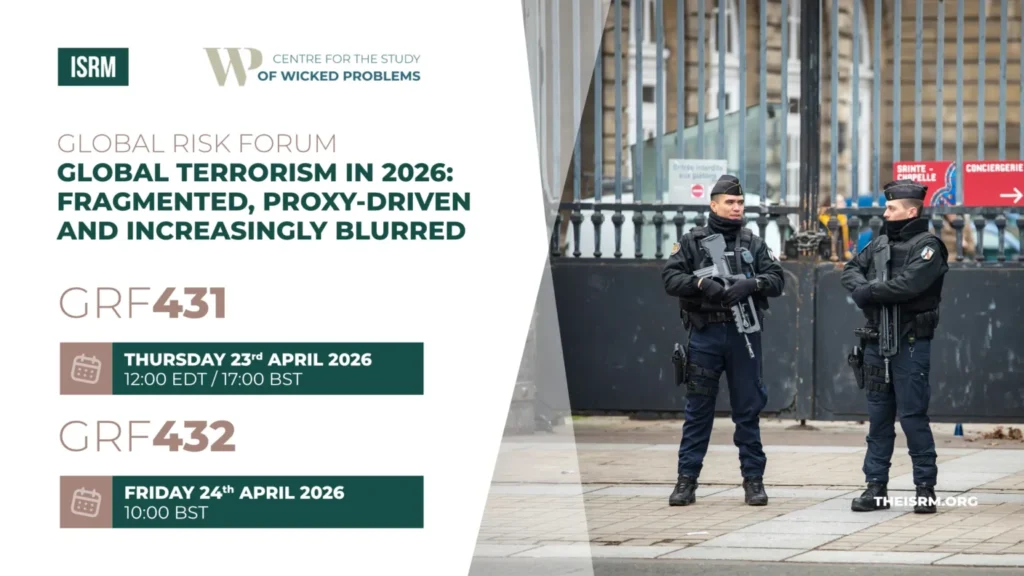
Join us this week for Global Risk Forums 431 & 432 as we look at how global terrorism is evolving in 2026. It’s a space to share ideas, hear different perspectives and have an open conversation – just what Global Risk Forum is all about. We’d really love to have you with us.
- Global Risk Forum 431
- Thursday, 23rd April at 17:00 BST / 12:00 EDT
- REGISTRATION >>
- Global Risk Forum 432
- Friday, 24th April at 10:00 BST
- REGISTRATION >>